
26
Whiskers
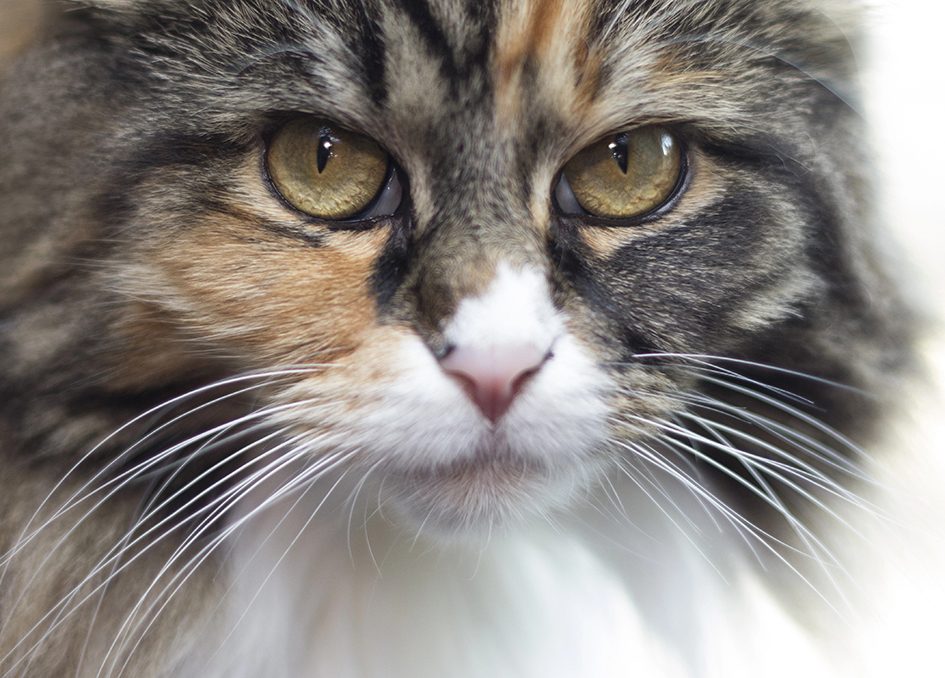
Cats have them. Rats have them. Elephants have them.
Elephants? really?
In the past a lot of attention has focussed on the elephant's trunk, with its extraordinary collection of 40,000 muscles (compared with 600 in the entire human body!). But not many know that this trunk is covered in about 1,000 special hairs. Very recent research carried out by the Max Planck Institute (published in 'Science Magazine' on 12 Feb 2026) has discovered that these hairs are unique in their construction and in the job that they can do as a result. This is how they summarise their work:
"Sense of touch despite thick elephant skin: Researchers have discovered that the hairs on elephants' trunks are responsible for their extraordinary sense of touch.
Special material properties: Elephant sensory hairs have a stiff base and a soft tip, which enables them to precisely feel objects and recognise where contact is made. These properties are similar to the whiskers of cats and differ from the completely stiff sensory hairs of rats and mice.
Applications in robotics: The findings will be used in the development of robot-assisted sensor technologies that mimic the stiffness gradient of elephant tactile hairs."
(For 4min Youtube video, see HERE)
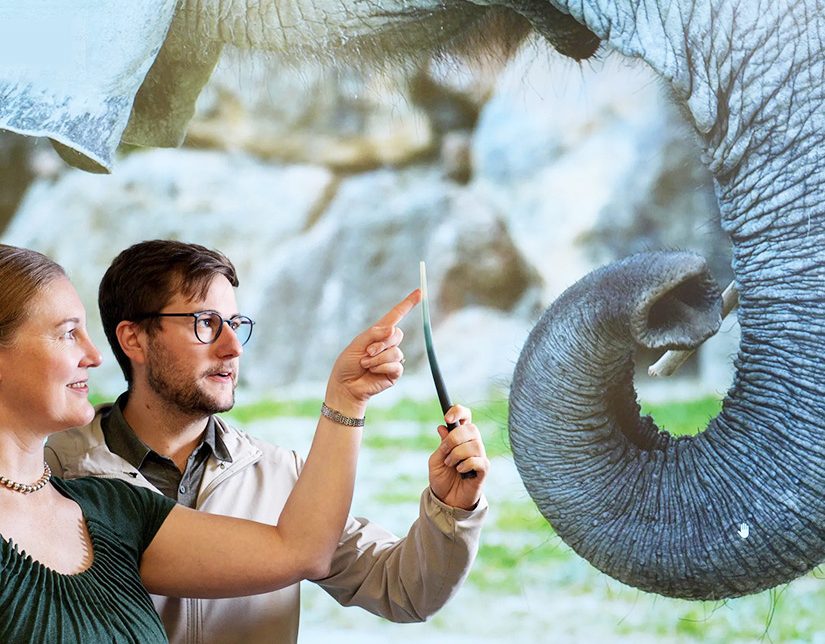
Enlarged model of an elephant whisker
MPI-IS/W Schieble
"The hundreds of fine hairs that cover an elephant's trunk are some of the most sophisticated and sensitive whiskers in the animal kingdom... Using microscope images, advanced computer models and a 3D-printed 'whisker wand', Schulz and his colleagues show how the structure of elephant whiskers makes their trunks uniquely capable of detecting motion, handling objects and performing complex tasks." (Washington Post).
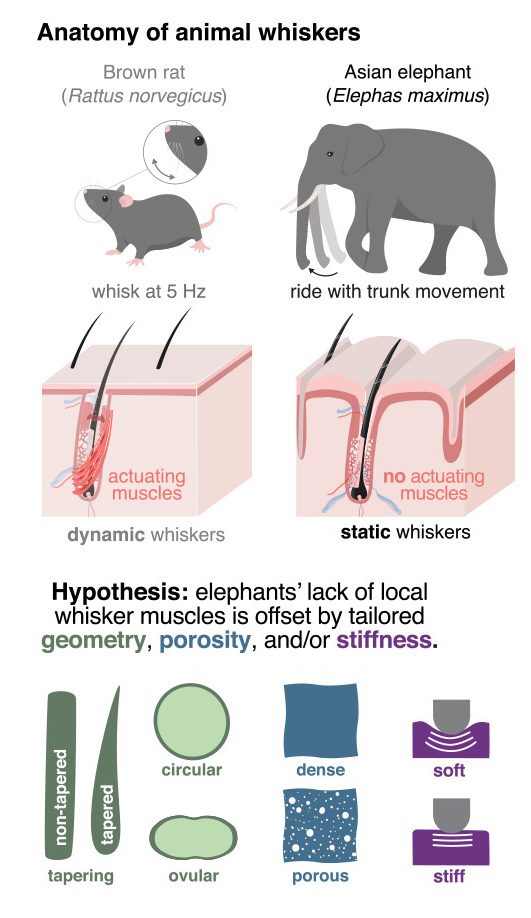
Their research included comparing the elephant's whiskers with those of rats – see these diagrams from their research paper.
So what's so special? "These organs are an example of what scientists call 'material intelligence'. Though the whiskers are inert, incapable of moving independently or thinking for themselves — their physical characteristics allow them to translate signals from the environment into information that can be conveyed to the brain." (Washington Post)
This is the essential difference between a whisker and a hair. Whiskers are active – they can send information to their host. Hair is different, part of an overall cladding or 'hide,' important for protection and insulation but otherwise passive apart from the usual growth and replacement. (The use of the term 'whiskers' to describe male fascial hair is a colloquial misuse of the term and not relevant here!)
All whiskers are made of keratin, the same protein found in hair as well as claws, hooves, horns and fingernails. But unlike ordinary hair, the follicles from which whiskers grow are surrounded by special cells (mechanoreceptors) that can detect mechanical movement when the whisker touches an object and can convey that information to the brain. It seems that the way that the elephant's whisker is constructed means that information is particularly detailed.
The whisker itself combines three different characteristics:
- It tapers from a broad base to a slender top, like a blade of grass.
- It is not circular, but a flattened ovoid in cross section.
- The broader base is quite porous in construction, changing to solid at the tip.
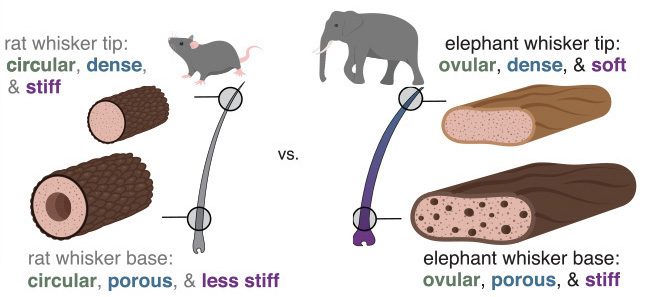
The teams of researchers used the most modern techniques at their disposal – "micro–computed tomography imaging, electron microscopy, mechanical testing, and finite element analysis to map out the structure and properties of these whiskers. At the base of the trunk, the whiskers are thick, circular, porous, and stiff, but they progress toward being thin, ovular, dense, and soft toward the tip, which contrasts with whiskers found in most other mammals. This combination of structure and form helps magnify the signals transmitted to the trunk." ('Science' Editor).
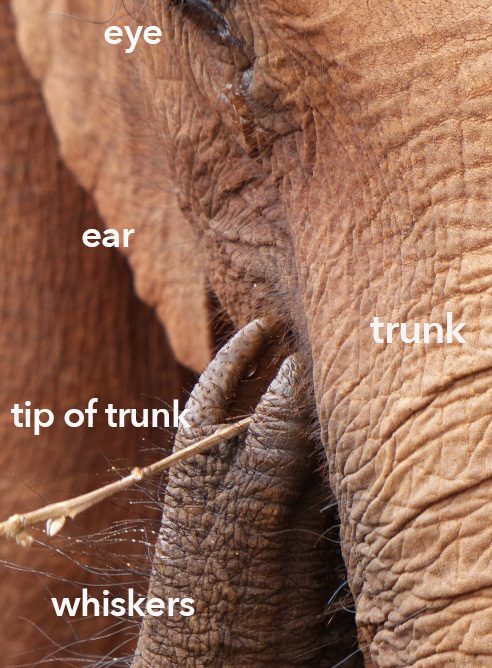
The tip of the trunk is sensitive enough to locate and grasp a single plant stem, using information fom its whiskers.
Picha Mzuri / shutterstock
The elephant's trunk already includes a complete nervous system devoted to controlling the thousands of muscles which give the trunk its power and its extraordinary sensitivity and dexterity. Now we must add to that a separate system collecting information from 1,000 touch-sensitive whiskers and sending it to the brain for interpretation and action.
All this, needless to say, is the result of evolution, so we are told.
Not that there is any evidence that this is the case, but this is the only option currently available if you are committed to a materialist view of the world.
So this undirected, blind assembly of accidents and information degradation which we call 'evolution' is deemed to be capable of what scientists themselves call 'material intelligence' – the laws of physics and chemistry alone supposedly responsible for information and intelligence in the natural world.
The researchers make no attempt to imagine how such a system could have evolved one tiny random step at a time.
They anticipate their research will help in the pursuit of more sensitive robotics.
It would be much more to the point if it opened their eyes to the Intelligence that is everywhere displayed in this astonishing world – to the Creator who designed and formed the cat and the elephant, and who endowed us with something of His own intelligence so that we might uncover the riches of His created work for ourselves.
We are happiest, we fulfil our true purpose, when we recognise and honour Him.