
25
Not in one basket
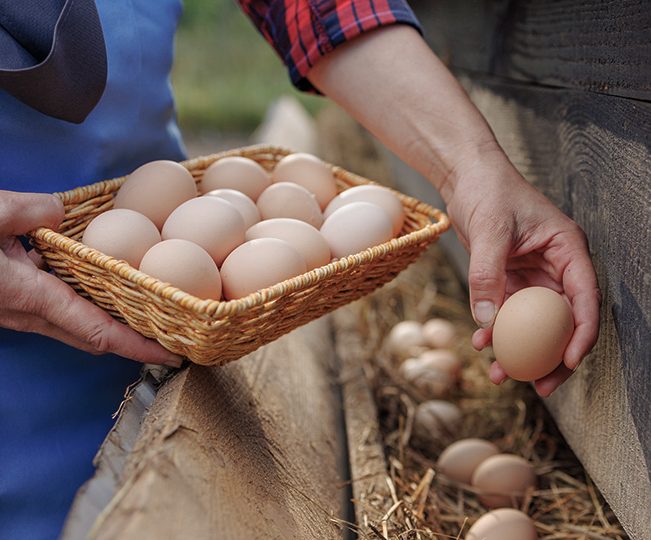
Segil Kolesnikov/istock
"If required on pain of death to name instantly the most perfect thing in the universe, I should risk my fate on a bird's egg."
So spoke Thomas Wentworth Higginson in 1862, quoted by well-known British naturalist and broadcaster David Attenborough.
He was introducing a TV programme on 'The Wonder of Eggs' in 2018. His own comment? 'I might do the same'. . .
"It is time," he says, "to reintroduce some wonder into this miracle of nature." Sadly, Attenborough does not believe in miracles of any sort, but we know what he means.
What is it about the egg that excites the 'wonder' of this seasoned naturalist?
There are about 10,000 different species of birds on this planet, as well as other creatures like fish and reptiles who use eggs to reproduce. A great deal of research has focussed on one bird in particular, the domestic chicken. What is so special about the familiar chicken egg.
Does it look as if it was designed?
Does it challenge the story of evolution?
The eggshell
First stop is the shell itself, the hard outer casing that protects the chick whilst it develops. It has to be strong enough to support the weight of the brooding mother but weak enough to allow the chick eventually to escape. It is 95–97% calcium carbonate (CaCO3) and a variety of proteins. The calcium comes from the hen's diet. There are several different layers within the shell, the outermost layer (the cuticle – see section) being the hardest and the inner ones softer.
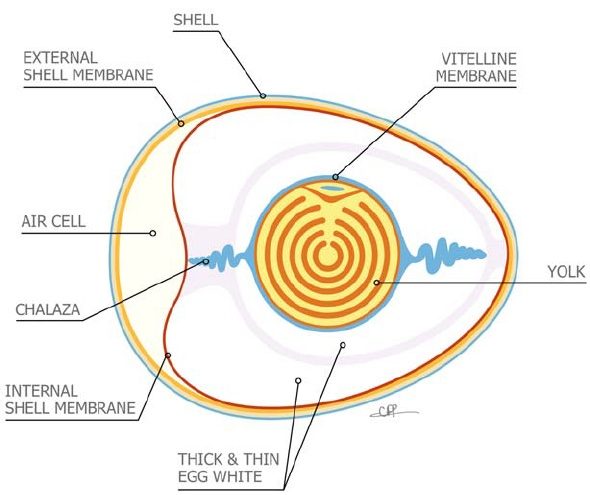
ResearchGate
There is a reason for that. One of the main materials the developing embryo requires is calcium to support bone growth. As the chick grows it absorbs and uses some of the calcium in the inner layer of the shell. This significantly weakens the shell, until eventually it is possible for the chick to break out of its temporary prison.
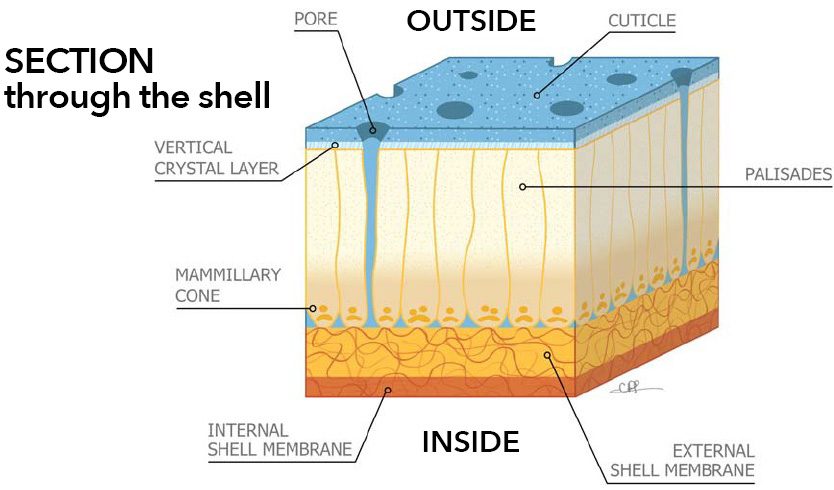
ResearchGate
How does the chick breathe during this period, because all the growth processes require oxygen (O2) as a fuel? The human baby derives oxygen from its mother via the umbilical cord, but the chick has no connection with its mother. The answer? The egg is not hermetically sealed but porous.The chicken egg has thousands (up to 17,000) of tiny pores (see diagram above), each less than one thousand of an inch across and quite invisible to the naked eye. These allow oxygen (O2) IN and the byproduct carbon dioxide (CO2) OUT, without weakening the protective role of the shell.
The membranes
On the inner face of the shell are two thin transparent membranes (called internal and external see top diagram ) – these are often quite obvious when you break an egg or peel a hard-boiled egg. When the egg cools after leaving the hen's body, its contents shrink slightly, pulling these two membranes apart. They are able to contain the oxygen which accumulates in the blunt end of the egg, and which enables the chick to start breathing three days before it hatches. Until then oxygen is transferred to the chick via a delicate network of capillaries (very tiny blood vessels) which press up against the membrane – "a high tech masterpiece of air treatment and control" (see Reference footnote).
The albumen or 'white' of the egg
The porosity of the shell, whilst essential for the chick's survival, also puts it in danger, because it allows potentially harmful bacteria to enter the shell with the oxygen. The albumen, mainly water with vitamins, minerals and protein, is laced with over 100 different anti-microbial proteins which deal with this problem, as well as cushioning the yolk sac.
The yolk
The yolk is the nutrient-rich food supply (with vitamins, fats and proteins) which powers the chick during its development. And not just the chick of course, but the billions of humans throughout history that have relied on eggs as an important part of their diet. Coincidence? or the foresight and wisdom of the Creator who designed both birds and humans? (compare the role of the bee's honey and its benefits for humanity, and a myriad plants of all sorts which also bring us great benefits).
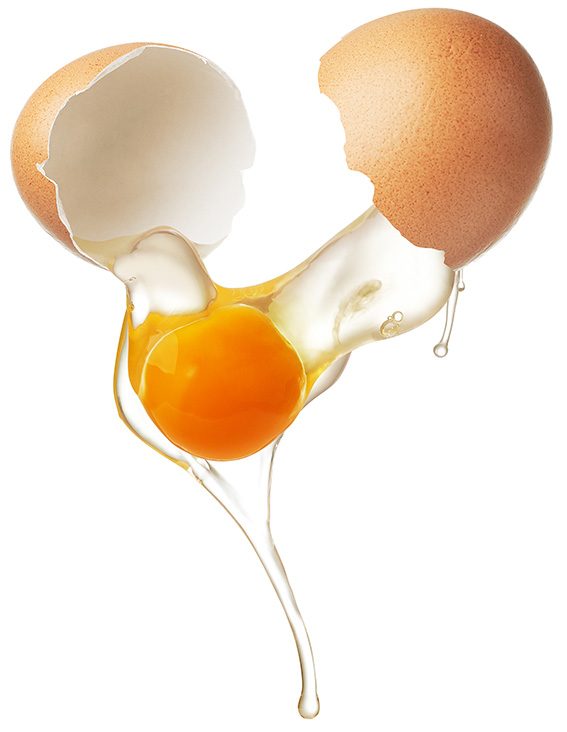
On the yolk is a small white spot. This is the germinal disc
and it contains the cells which will develope into a chick
if the egg is fertile.
phive2015/istock
The egg tooth
This is a small sharp temporary cap which sits on the end of the chick's upper beak and begins to develop after the seventh day inside the egg. As hatching comes close (after 21 days) the cap becomes hard and sharp so the chick can use it to break through the inner membrane and access the air sac in the shell's blunt end. It can then start breathing and growing stronger up to three days before hatching. Finally, after breaking through the shell, the egg tooth, its job done, falls off or is absorbed into the rest of the beak.
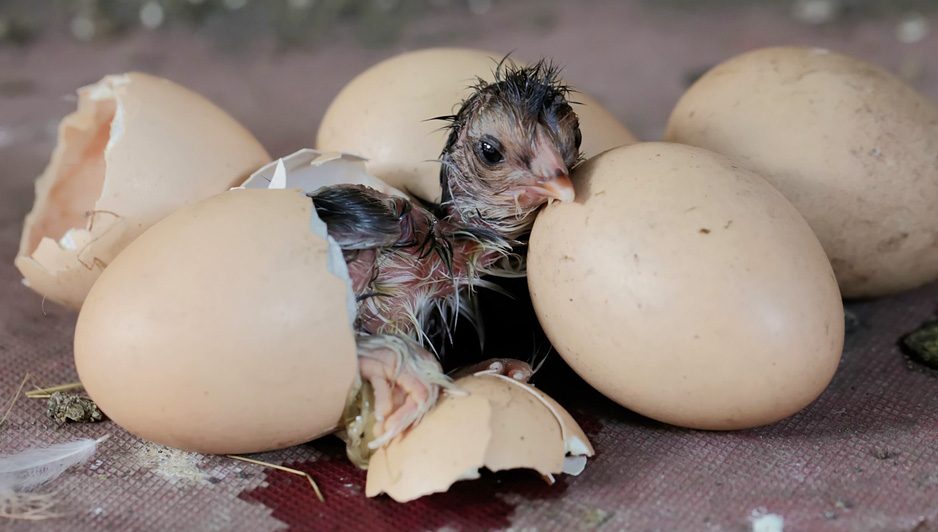
The time comes for the chick to liberate itself from the shell by pecking at it from inside, a process called 'pipping'. Instinctively it begins to rotate its body, pecking at and weakening a roughly horizontal groove around the inside of the blunt end of the shell until eventually the cap breaks free, and a new, very bedraggled chick (Gallus gallus domesticus) enters the world.
Wayan Sumatika/shutterstock
Evolution
Attenborough's TV programme is still available on BBC iPlayer.
But if you expect it to give you some important clues about how the egg evolved, you will be disappointed. Most of the programme looks at the different shapes of eggs (pointed or blunt-ended) that characterise different birds, and why that might be. Attenborough himself calls the egg "nature's most perfect life-support system", but does not begin to explain its origin.
There's a good reason for that. It is quite impossible to envisage how such a perfectly choreographed support system could emerge from the blind procession of tiny accidents which is called evolution.
University of Birmingham
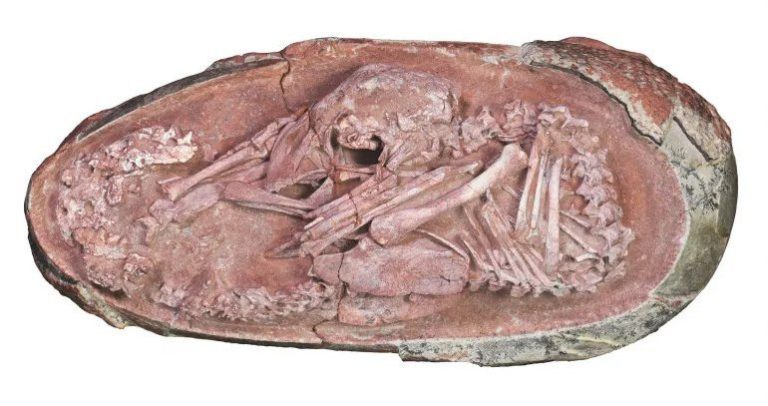
Fossilised embryo of oviraptorosaur still in its egg
The evidence
Thousands of fossilised eggs have been discovered, and it is not always clear what animal they belong to. They appear fully formed and functional – some still contain the tiny but perfect embryos of the dinosaurs that laid them. However old you may believe the dinosaurs to be, their eggs were already fully functional and doing a good job, otherwise no dinosaurs!
NASA
LIFE SUPPORT
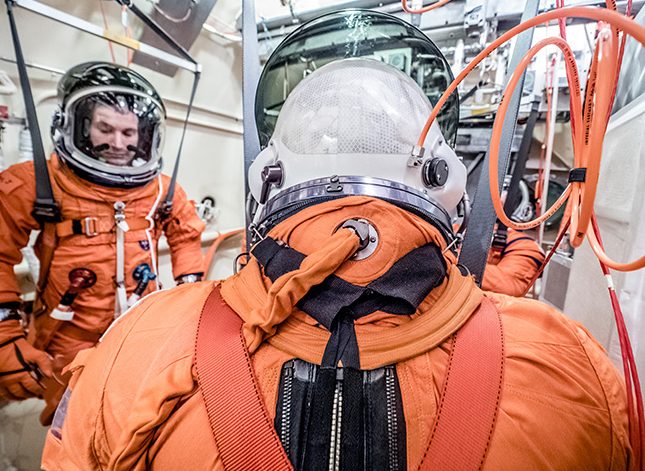
We know about life support.
We have designed support systems for space exploration, for deep sea diving, for dealing with contamination of all sorts, for the desperately ill or injured. We know exactly what is required, the design constraints which have to be met for survival. There is no room for guesswork, for trial and error, for the haphazard or the jerry-built.
The egg in so many ways meets exactly the requirements of its tiny tenant. The shell, the white, the yoke, the egg tooth, all working together, supply precisely what is needed, when it is needed.
If they did not, new life would come to an end.
Faced with these remarkable facts, how can we not respond with 'wonder'?
More than that, our minds need to be open to the evidence for the great Creator who designed our tiny planet and its myriad inhabitants – a miraculous wellspring of life in this vast cosmos – and will one day purge it from everything that presently corrupts it.
Reference:
'Foresight' Marcos Eberlin Discovery Institute Press 2019
Eberlin is former President of the International Mass Spectrometry Foundation